How to tell beech from oak in winter canopy imagery
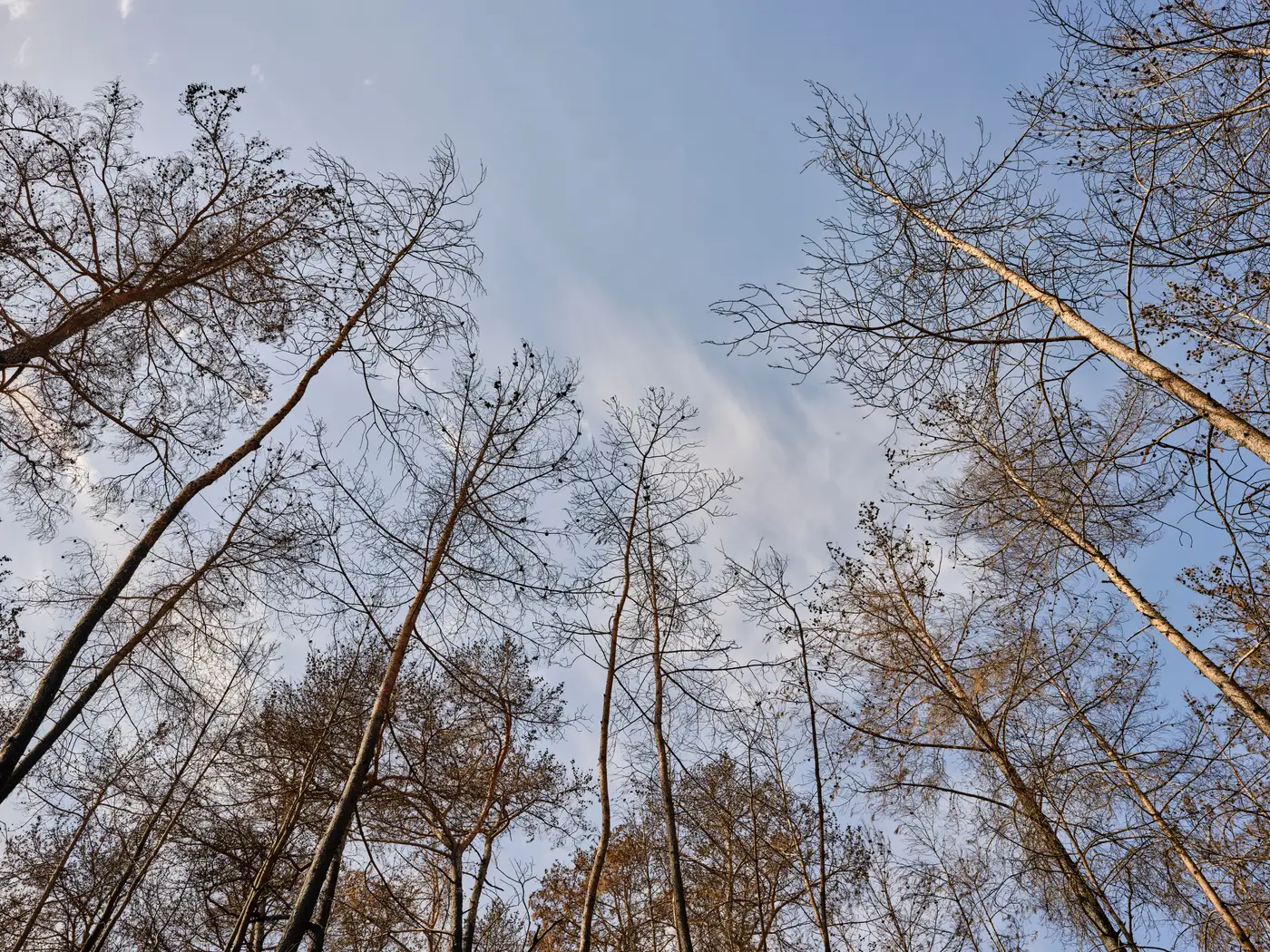
Beech and oak overlap on enough sites that "mixed hardwood compartment" ends up meaning "we'll sort it out at marking time." In winter, when the canopy is bare and you're working off imagery instead of a walk-through, the two can blur into the same gray-brown mass unless you know what you're looking for.
The good news is that leaf-off season is actually one of the better windows for telling them apart, not a worse one. Summer canopy hides crown architecture under a solid green dome. Winter strips that away and leaves the structure exposed, which is most of what separates these two species anyway.
Marcescence is the giveaway, if the timing is right
European and American beech are marcescent on a good portion of their crowns, meaning they hold onto dead, bleached-tan leaves well into winter instead of dropping them clean in fall like oak mostly does. On imagery flown in December or January, a beech-heavy stand often shows a pale, almost straw-colored cast through the upper and mid-crown that oak crowns don't carry. Oak drops earlier and more completely, so by true dormant season its crowns read as bare branch structure with little residual leaf color.
This only works as a signal in the right window. Fly too early in the leaf-off transition (say, early November in a lot of temperate ranges) and both species may still be holding partial leaf. Fly too late into winter, after wind and ice have stripped even the marcescent leaves, and the color cue fades out. Cadence matters here more than most people think when they're scoping a winter capture.
Crown texture and branching tell the rest of the story
Once leaf color stops being reliable, texture and branching pick up the slack. Oak crowns tend to run coarser: thick, often sinuous primary branches with a more open, irregular silhouette, especially in white oak and bur oak. Beech crowns are finer-textured, with denser twig structure and a smoother, rounder outline. On high-resolution winter imagery this shows up as a difference in crown "grain," oak reading rougher and more broken, beech reading tighter and uniform, almost like a different weave of the same fabric.
Bark visibility helps too in gaps and edge rows. Beech bark stays smooth and pale gray through maturity, which can show through thinner winter crowns as a lighter trunk signature than the furrowed, darker bark typical of most oaks. It's a confirming signal, useful for backing up a call you're already leaning toward from crown texture.
Where this breaks down on a real compartment
None of this holds up cleanly on a single aerial photo eyeballed at normal zoom. Marcescence varies by individual tree, by exposure, by how hard the wind has blown that winter, and co-dominant beech under an oak overstory can hide its leaf signal entirely. Crown texture differences get harder to read once stocking is dense enough that crowns are touching and compressed. And this whole discussion has only covered beech versus oak. Most working compartments carry maple, birch, ash, and conifer intermixed, and a visual read that works for two species doesn't scale to a six-species stand without a lot of staring at a screen.
That's the actual argument for narrow-band reflectance and seasonal phenology doing this work instead of a cruiser's eye on an orthophoto. Pulling multiple spectral bands plus the dormant-season signal across an entire holding, rather than guessing crown texture compartment by compartment, is what Tree Species Mapping is built to do: a wall-to-wall species layer, conifer separated from broadleaf and often species from species, run annually instead of re-estimated from sample plots every cruise cycle.
If you're staring at leaf-off imagery trying to decide where the beech ends and the oak starts, it might be worth seeing what a compartment-by-compartment species layer looks like for your own holding.