Larch dieback or normal thinning? Reading canopy condition in aerial imagery
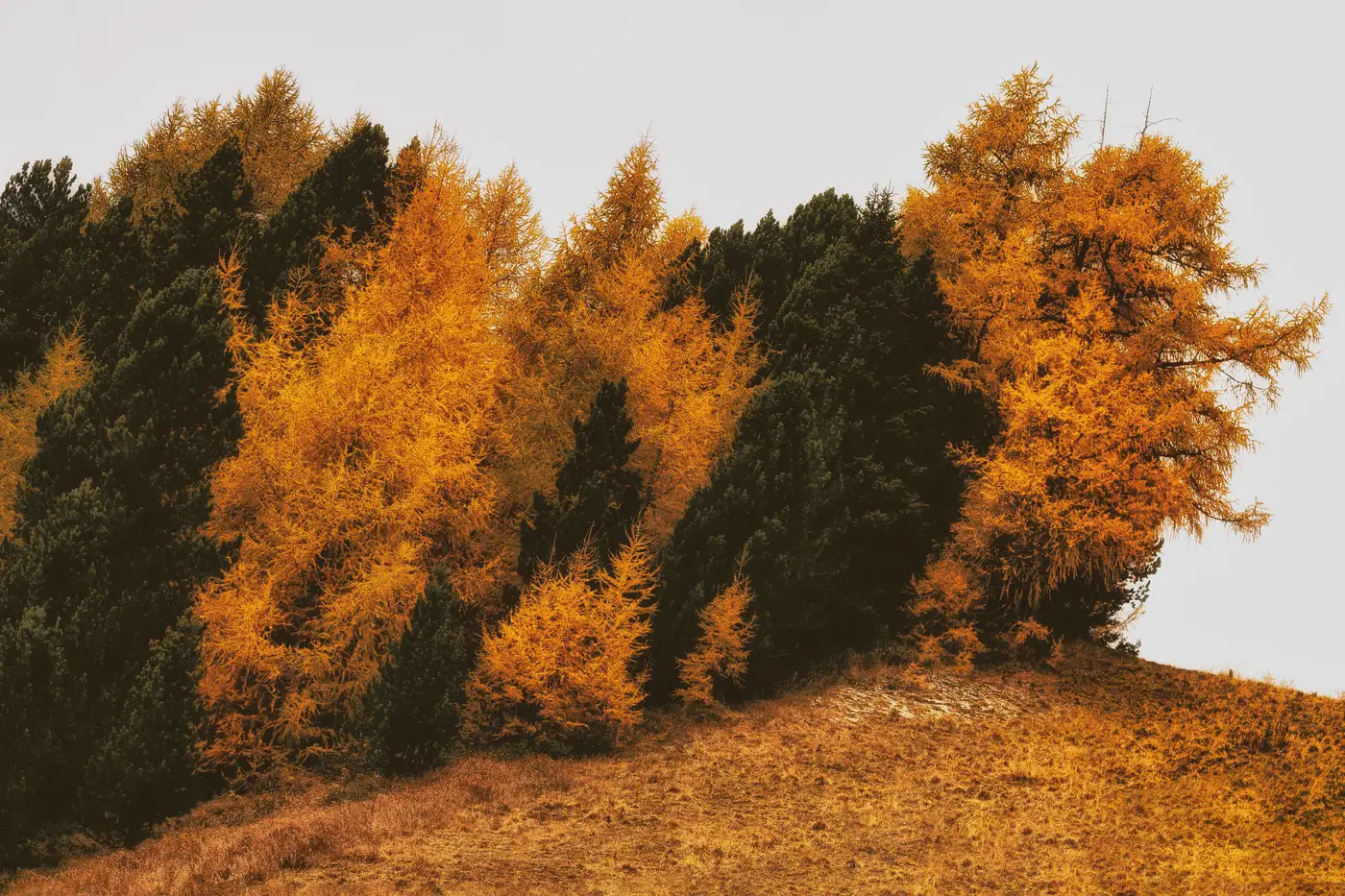
Larch is the one conifer on the compartment map that's supposed to go bare every winter. That's exactly what makes a dieback call from imagery alone so easy to get wrong. A stand with early, patchy needle loss in September could be ordinary seasonal senescence running ahead of schedule on a dry site, a recent thinning operation that's opened up the canopy in a regular pattern, or Phytophthora ramorum working through the crowns. From the office, before anyone's walked the compartment, those three things can look uncomfortably similar on a screen.
Getting the call wrong has a cost either way. Flag a disease symptom that's really just this year's needle cast running early, and you've triggered a site visit and maybe a report nobody needed. Miss a genuine infection because you read it as thinning, and the stand keeps shedding spores into neighbouring larch while the statutory clock on reporting isn't even running yet.
What normal larch canopy condition looks like through the season
European and Japanese larch are deciduous conifers, so a healthy stand runs through a predictable colour and density cycle: fresh green flush in spring, a long stable green crown through summer, then a uniform shift to gold or russet in autumn before needle drop. The key word is uniform. In a healthy compartment the colour change moves through the stand roughly together, tree to tree, and the crown stays intact in shape, just less dense as needles fall. Imagery taken a few weeks either side of peak colour change can look dramatically different between flights even with nothing wrong on the ground, which is the main trap when you're comparing two dates without checking what day each was actually flown.
Thinning reads differently again. A recent felling operation leaves gaps with hard, straight edges, racked brash lines, and extraction routes, all geometric and tied to rack spacing rather than tree condition. The remaining crowns around a thinned area stay a normal colour and shape for the time of year. If what you're looking at follows the rack pattern rather than following individual tree crowns, that's management, not disease.
What Phytophthora ramorum symptoms look like from above
P. ramorum dieback breaks both of those patterns. Instead of moving through the stand together, symptomatic trees show up scattered, often starting at the top of the crown and spreading down, with needles turning off-colour, bronzing or blackening out of step with the surrounding trees rather than with them. Crown transparency increases unevenly tree to tree rather than canopy-wide. On the ground the confirming sign is resin bleed, a dark, tarry ooze on the lower bole, but that's invisible from above, which is exactly why imagery alone can flag a suspect compartment but can't close out the diagnosis.
The pattern to watch for in a time series is asynchrony: trees within metres of each other moving at different rates and in different directions through a season when the rest of the stand should be moving together. One golden crown next to one that's already bare and blackened in early autumn is a stronger signal than either colour on its own.
Where photo interpretation runs out
Single-date aerial imagery, read without knowing flight date against local phenology, is a weak basis for a dieback call either way. What holds up is a time series through the growing season compared compartment by compartment, so a thinned block, a naturally early stand, and a genuinely declining one don't get lumped into the same "canopy loss" category. That's the gap a species-and-condition layer run annually across a holding is built to close, rather than relying on a handful of sample plots to stand in for the whole estate. If larch is a meaningful part of your holding, a wall-to-wall species layer run every season gives you something to check a suspect compartment against before you commit a felling notice or a field visit to it.
Either way, treat any suspect patch as a prompt for ground truth, not a conclusion. A resin-bled bole and a plant health inspector's confirmation are still what makes the call, imagery just tells you where to send them first.